This website is managed by Ultima Markets’ international entities, and it’s important to emphasise that they are not subject to regulation by the FCA in the UK. Therefore, you must understand that you will not have the FCA’s protection when investing through this website – for example:
You will not be guaranteed Negative Balance Protection
You will not be protected by FCA’s leverage restrictions
You will not have the right to settle disputes via the Financial Ombudsman Service (FOS)
You will not be protected by Financial Services Compensation Scheme (FSCS)
Any monies deposited will not be afforded the protection required under the FCA Client Assets Sourcebook. The level of protection for your funds will be determined by the regulations of the relevant local regulator.
Note: UK clients are kindly invited to visit https://www.ultima-markets.co.uk/. Ultima Markets UK expects to begin onboarding UK clients in accordance with FCA regulatory requirements in 2026.
If you would like to proceed and visit this website, you acknowledge and confirm the following:
1.The website is owned by Ultima Markets’ international entities and not by Ultima Markets UK Ltd, which is regulated by the FCA.
2.Ultima Markets Limited, or any of the Ultima Markets international entities, are neither based in the UK nor licensed by the FCA.
3.You are accessing the website at your own initiative and have not been solicited by Ultima Markets Limited in any way.
4.Investing through this website does not grant you the protections provided by the FCA.
5.Should you choose to invest through this website or with any of the international Ultima Markets entities, you will be subject to the rules and regulations of the relevant international regulatory authorities, not the FCA.
Ultima Markets wants to make it clear that we are duly licensed and authorised to offer the services and financial derivative products listed on our website. Individuals accessing this website and registering a trading account do so entirely of their own volition and without prior solicitation.
By confirming your decision to proceed with entering the website, you hereby affirm that this decision was solely initiated by you, and no solicitation has been made by any Ultima Markets entity.
Ultima Markets does not have an establishment in Singapore and does not operate from Singapore.
Ultima Markets does not provide products or services to citizens or residents of Singapore, and account applications from Singapore citizens or residents will not be accepted.
If you are a citizen or resident of Singapore, please do not open an account or use Ultima Markets’ products or services.
By selecting “Acknowledge and Continue Browsing”, you confirm that you are accessing this website on your own initiative and that your access is not the result of any direct marketing, targeted advertising, solicitation, or promotional activity by Ultima Markets.
Nothing on this website constitutes an offer, solicitation, or promotion of products or services in any jurisdiction where such activity is prohibited. You are responsible for ensuring that your access to and use of this website complies with applicable local laws and regulations.
Learn what is an IV percentile. See how implied volatility percentile works and how traders use it to evaluate options pricing and strategies effectively.
IV percentile, also called implied volatility percentile, is a tool that options traders use to determine whether options are relatively cheap or expensive. It shows how current implied volatility compares with historical levels over a specific period, usually one year.
Key Concept
IV percentile measures the frequency at which past implied volatility readings were lower than today’s value.
Example: An IV percentile of 80% means current implied volatility is higher than it was 80% of the time in the past year.
IV percentile provides context that raw implied volatility cannot, helping traders answer: is today’s volatility high or low relative to its own history?
Understanding Implied Volatility
Before exploring IV percentile, it helps to understand implied volatility (IV). Implied volatility represents the market’s expectation of how much an asset may move over a certain period, inferred from option prices.
When implied volatility rises, option premiums increase because the likelihood of the option finishing in the money becomes greater. When implied volatility falls, premiums typically decrease.
Common events that influence implied volatility include:
Earnings announcements
Federal Reserve or central bank decisions
Economic reports such as GDP or CPI
Geopolitical developments
Large price swings in the underlying stock
By itself, implied volatility does not indicate whether an option is cheap or expensive historically. This is where IV percentile becomes essential.
How IV Percentile Is Calculated
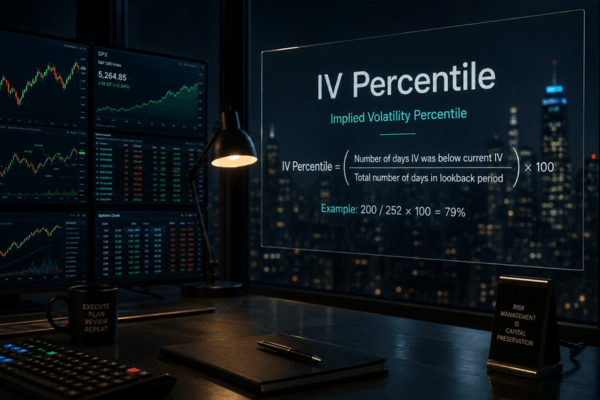
IV percentile measures the proportion of past days when implied volatility was below the current level.
Formula:
IV Percentile=Number of days IV was below current IVTotal number of days in lookback period×100IV Percentile=Total number of days in lookback periodNumber of days IV was below current IV×100
Example:
Stock XYZ
Lookback period: 252 trading days (1 year)
Current IV: 55%
Days when IV was lower than 55%: 200
This shows that current implied volatility is higher than 79% of past readings, suggesting options are relatively expensive compared with the past year.
IV Percentile vs. IV Rank
Many traders confuse IV percentile with IV rank, but they are different measures.
IV Percentile: Shows how often IV was below the current level. It is frequency-based.
IV Rank: Measures where current IV sits between the historical high and low.
IV Rank formula:
While IV rank provides a position relative to extremes, IV percentile indicates how unusual the current IV is compared to its history. This often gives a more practical sense of option pricing conditions.
Why Does Implied Volatility Percentile Matter
IV percentile is important because it helps traders decide:
Strategy selection: High IV percentile environments may favour options selling strategies, while low IV percentile environments may favour buying options.
Trade timing: Traders can gauge whether entering a trade now is advantageous or if waiting for a shift in IV might improve entry points.
Risk assessment: Elevated IV percentile signals larger expected moves and increased option premiums, but also higher risk.
Stock comparison: Comparing IV percentile across stocks allows traders to evaluate relative option pricing rather than absolute implied volatility.
For example, Tesla options might have a current IV of 55%, while SPY options sit at 30%.
However, Tesla’s IV percentile may be 70% and SPY’s 80%. This indicates SPY options are historically more expensive despite the lower raw IV, guiding traders’ strategy choices.
High IV Percentile vs. Low IV Percentile
High IV Percentile
When IV percentile is high, implied volatility is elevated relative to historical norms. This often results from upcoming earnings or significant market events. High IV percentile suggests:
Options are relatively expensive
The market anticipates larger price swings
Premium-selling strategies, such as credit spreads, iron condors, or covered calls, may be considered
High IV percentile also increases risk. Traders must assess why volatility is high and whether a major move is likely.
Low IV Percentile
Low IV percentile indicates implied volatility is lower than usual. This often occurs in calm markets with little expected movement. Low IV percentile implies:
Options are relatively cheap
The market expects smaller price changes
Buying strategies, such as long calls, long puts, or debit spreads, may be attractive
Low IV percentile alone does not guarantee a profitable trade. A stock may remain stagnant or IV may rise, affecting option premiums.
IV Percentile and Earnings
Earnings announcements often cause implied volatility to spike, raising the IV percentile. After earnings, IV often drops sharply, a phenomenon called IV crush, which can reduce option premiums even if the stock moves in the expected direction.
For instance, a stock with a 90% IV percentile before earnings may see implied volatility fall to 40% afterward. Traders need to factor this into options pricing and strategy selection.
How to Use IV Percentile in Your Trades
Traders can use the implied volatility percentile alongside other metrics for better decisions:
Combine with Greeks: Understanding delta, theta, and vega can help traders see how IV affects option value.
Check liquidity: High IV percentile with low liquidity can create wide spreads and impact trade execution.
Observe implied volatility skew: Compare IV percentile across strike prices to spot market sentiment and potential directional bias.
Use multiple lookback periods: Comparing 3-month vs. 12-month IV percentile can provide insights into short-term vs. long-term volatility expectations.
Limitations of the IV Percentile
While IV percentile is useful, it has limitations:
Dependent on lookback period: A 1-year IV percentile may differ significantly from a 3-month calculation.
Does not predict direction: IV percentile shows relative volatility, not stock price movement.
High IV may persist: Elevated IV can remain high, and low IV can remain low for extended periods.
Affected by outliers: Extreme past volatility events can skew the percentile.
Traders should use IV percentile in combination with market context, technical analysis, and fundamental analysis for better-informed decisions.
Typical IV Percentile Ranges
IV Percentile
Interpretation
0%–25%
Low implied volatility
25%–50%
Below-average to moderate IV
50%–75%
Above-average IV
75%–100%
High implied volatility
These ranges are general guidelines, not trading rules. A high IV percentile may make selling options appealing, but risk remains. A low IV percentile may suggest cheaper premiums for buyers, but the underlying stock may not move enough.
Conclusion
IV percentile is a valuable measure for options traders, giving context to implied volatility and helping determine whether options are relatively cheap or expensive.
By combining implied volatility percentile with strategy choice, trade timing, risk management, and other tools like option Greeks, traders can make more informed decisions. It provides a practical framework to assess market conditions, compare options across stocks, and adjust strategies according to volatility expectations.
While it is not predictive of direction, using implied volatility percentile wisely can improve understanding of option pricing dynamics and potential risk exposure.
FAQs
What is a good IV percentile to buy options?
Generally, lower IV percentile options are cheaper, but strategy, stock movement, and timing should guide decisions.
How does IV percentile differ from implied volatility?
IV percentile shows where current implied volatility stands relative to its history, while implied volatility is the raw market expectation of movement.
Can IV percentile predict stock price direction?
No, it measures volatility relative to history, not price direction.
Share Now
Disclaimer:This content is provided for informational purposes only and does not constitute, and should not be construed as, financial, investment, or other professional advice. No statement or opinion contained herein should be considered a recommendation by Ultima Markets or the author regarding any specific investment product, strategy, or transaction. Readers are advised not to rely solely on this material when making investment decisions and should seek independent advice where appropriate.
Thank you for visiting the Ultima Markets website. Please note that this website is intended for individuals residing in jurisdictions where access is permitted by law. Ultima and its affiliated entities do not operate in your home jurisdiction.
By clicking ‘Acknowledge’, you confirm that you are entering this website solely on your own initiative and not as a result of any specific marketing outreach. You wish to obtain information from this website based on reverse solicitation principles, in accordance with the applicable laws of your home jurisdiction.