This website is managed by Ultima Markets’ international entities, and it’s important to emphasise that they are not subject to regulation by the FCA in the UK. Therefore, you must understand that you will not have the FCA’s protection when investing through this website – for example:
You will not be guaranteed Negative Balance Protection
You will not be protected by FCA’s leverage restrictions
You will not have the right to settle disputes via the Financial Ombudsman Service (FOS)
You will not be protected by Financial Services Compensation Scheme (FSCS)
Any monies deposited will not be afforded the protection required under the FCA Client Assets Sourcebook. The level of protection for your funds will be determined by the regulations of the relevant local regulator.
Note: UK clients are kindly invited to visit https://www.ultima-markets.co.uk/. Ultima Markets UK expects to begin onboarding UK clients in accordance with FCA regulatory requirements in 2026.
If you would like to proceed and visit this website, you acknowledge and confirm the following:
1.The website is owned by Ultima Markets’ international entities and not by Ultima Markets UK Ltd, which is regulated by the FCA.
2.Ultima Markets Limited, or any of the Ultima Markets international entities, are neither based in the UK nor licensed by the FCA.
3.You are accessing the website at your own initiative and have not been solicited by Ultima Markets Limited in any way.
4.Investing through this website does not grant you the protections provided by the FCA.
5.Should you choose to invest through this website or with any of the international Ultima Markets entities, you will be subject to the rules and regulations of the relevant international regulatory authorities, not the FCA.
Ultima Markets wants to make it clear that we are duly licensed and authorised to offer the services and financial derivative products listed on our website. Individuals accessing this website and registering a trading account do so entirely of their own volition and without prior solicitation.
By confirming your decision to proceed with entering the website, you hereby affirm that this decision was solely initiated by you, and no solicitation has been made by any Ultima Markets entity.
Ultima Markets does not have an establishment in Singapore and does not operate from Singapore.
Ultima Markets does not provide products or services to citizens or residents of Singapore, and account applications from Singapore citizens or residents will not be accepted.
If you are a citizen or resident of Singapore, please do not open an account or use Ultima Markets’ products or services.
By selecting “Acknowledge and Continue Browsing”, you confirm that you are accessing this website on your own initiative and that your access is not the result of any direct marketing, targeted advertising, solicitation, or promotional activity by Ultima Markets.
Nothing on this website constitutes an offer, solicitation, or promotion of products or services in any jurisdiction where such activity is prohibited. You are responsible for ensuring that your access to and use of this website complies with applicable local laws and regulations.
What is a fill or kill order? Discover how FOK orders work and their benefits and risks. Learn the differences from limit and immediate or cancel orders.
When markets move quickly, getting only part of a trade executed can create unexpected risks. A fill or kill order gives traders a simple choice: execute the entire order immediately or cancel it completely.
A fill or kill order is commonly used by professional traders and institutions that need precise execution, especially when dealing with large positions or fast-moving markets. Instead of allowing an order to be partially completed, this order type ensures traders either receive the full amount they requested or do not enter the trade at all.
In this article, we will explain what is a fill or kill order, how it works, its advantages and disadvantages, and how it compares with other common trading orders.
What Is a Fill or Kill Order?
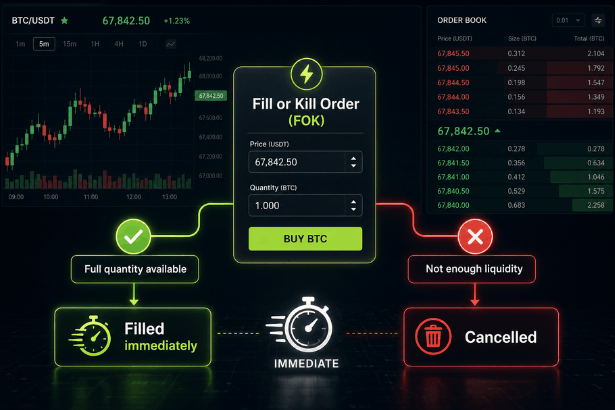
A fill or kill order is a trading instruction that requires an order to be executed in full immediately at a specified price or cancelled completely.
The term comes from two possible outcomes:
Fill: The entire order is executed immediately.
Kill: If the full order cannot be completed, the order is cancelled.
Unlike a standard limit order, where an investor can wait for the market to reach a desired price, a fill or kill order does not remain active. The decision happens instantly.
For example, a trader places an order to buy 10,000 shares at $50 per share. If 10,000 shares are available at that price, the order is completed. However, if only 8,000 shares are available, the entire order is cancelled.
This prevents the trader from receiving only a partial position.
How Does a Fill or Kill Order Work?
A fill or kill order is a type of time-in-force order, which tells a broker how an order should be handled and how long it should remain active.
The process is straightforward:
A trader specifies the asset, price, and quantity.
The broker checks whether the entire order can be matched immediately.
If the full order is available, the trade is executed.
If the full order cannot be completed, the order is automatically cancelled.
Example of a Fill or Kill Order
A trader wants to purchase 20,000 shares of a company at $25.
Order Detail
Example
Order type
Fill or Kill
Asset
Company shares
Quantity
20,000 shares
Target price
$25
Execution rule
Complete order immediately or cancel
Scenario 1: Successful execution
There are 20,000 shares available at $25. The order is filled.
Scenario 2: Order cancelled
Only 12,000 shares are available at $25. Because the full quantity cannot be completed, the order is killed.
Why Do Traders Use Fill or Kill Orders?
The main reason traders use a fill or kill order is to maintain greater control over execution.
Avoid Partial Fills
Partial fills can create problems, especially for traders managing larger positions. Receiving only part of an order may leave a trader with an incomplete strategy or unwanted market exposure.
For example, an institutional investor planning to purchase a large position may not want to buy only half of the intended amount because the remaining shares could become more expensive later.
A fill or kill order removes this uncertainty by requiring complete execution.
Execute Large Orders Efficiently
Professional traders often use fill or kill orders for block trades, where they need to buy or sell large amounts of an asset quickly.
This is especially useful when the trader wants to enter or exit a position at a specific market condition without gradually building the position.
Support Short-Term Trading Strategies
Some short-term traders use fill or kill orders when price opportunities exist only briefly. This can be useful in strategies such as arbitrage, where traders attempt to take advantage of small price differences across markets.
Fill or Kill vs Other Order Types
Understanding how a fill or kill order differs from other order types can help traders choose the right execution method.
Order Type
How It Works
Partial Fill Allowed?
Market Order
Executes immediately at the best available price
Yes
Limit Order
Executes at a chosen price or better
Yes
Fill or Kill Order
Entire order executes immediately or is cancelled
No
Immediate or Cancel Order
Executes available quantity immediately and cancels the rest
Yes
All or None Order
Requires the entire order quantity to be filled
No
Fill or Kill vs Immediate or Cancel Orders
A common confusion is the difference between fill or kill and immediate or cancel (IOC) orders.
Both require immediate action, but the key difference is partial execution.
A fill or kill order requires the entire order to be completed. If any part of the order cannot be filled, the trade is cancelled.
An IOC order allows partial execution. For example, if a trader wants to buy 10,000 shares but only 6,000 are available, the IOC order can execute the 6,000 shares and cancel the remaining 4,000.
Fill or Kill vs All or None Orders
Fill or kill and all or none (AON) orders have a similar goal because both prevent partial fills. However, the timing requirement is different.
Feature
Fill or Kill
All or None
Full order required
Yes
Yes
Immediate execution required
Yes
No
Can remain open
No
Yes
A fill or kill order means “execute now or cancel”, while an all or none order means “complete the full order, but waiting is acceptable”.
Advantages and Disadvantages of Fill or Kill Orders
A fill or kill order can be useful, but it is not suitable for every trading situation.
Advantages
Disadvantages
Prevents unwanted partial fills
Lower chance of execution
Provides precise position control
May miss trading opportunities
Useful for large transactions
Requires sufficient market liquidity
Reduces manual monitoring
Not available on every platform
The biggest limitation is liquidity. If there are not enough buyers or sellers available at the required price, the order will fail.
For example, if a trader wants to buy 50,000 shares but only 30,000 shares are available, the order will be cancelled.
Fill or Kill Orders in Forex and CFD Trading
In forex and CFD markets, execution depends on liquidity, market conditions, and broker infrastructure. During periods of high volatility, such as major economic announcements or central bank decisions, available liquidity can change quickly.
Although fill or kill orders are more commonly associated with exchange-traded markets, traders using advanced order types should always understand how their broker handles execution conditions.
Before using a fill or kill order, traders should check whether the feature is supported on their trading platform and whether it matches their trading strategy.
Conclusion
A fill or kill order is designed for traders who need immediate and complete execution. By requiring the entire order to be filled or cancelled, it helps prevent partial fills and gives traders more control over their positions.
However, this strict requirement also means the order may fail more frequently, especially in markets with lower liquidity. Traders should consider their strategy, market conditions, and execution needs before deciding whether a fill or kill order is suitable.
FAQs
What is a fill or kill order?
A fill or kill order is a trading order that must be fully executed immediately or cancelled completely.
What happens if a fill or kill order cannot be filled?
The order is automatically cancelled and no trade takes place.
Is a fill or kill order the same as a limit order?
No. A limit order can remain open, while a fill or kill order must execute immediately or be cancelled.
Who uses fill or kill orders?
They are commonly used by professional traders, institutions, and investors managing large orders.
Share Now
Disclaimer:This content is provided for informational purposes only and does not constitute, and should not be construed as, financial, investment, or other professional advice. No statement or opinion contained herein should be considered a recommendation by Ultima Markets or the author regarding any specific investment product, strategy, or transaction. Readers are advised not to rely solely on this material when making investment decisions and should seek independent advice where appropriate.
Thank you for visiting the Ultima Markets website. Please note that this website is intended for individuals residing in jurisdictions where access is permitted by law. Ultima and its affiliated entities do not operate in your home jurisdiction.
By clicking ‘Acknowledge’, you confirm that you are entering this website solely on your own initiative and not as a result of any specific marketing outreach. You wish to obtain information from this website based on reverse solicitation principles, in accordance with the applicable laws of your home jurisdiction.