This website is managed by Ultima Markets’ international entities, and it’s important to emphasise that they are not subject to regulation by the FCA in the UK. Therefore, you must understand that you will not have the FCA’s protection when investing through this website – for example:
You will not be guaranteed Negative Balance Protection
You will not be protected by FCA’s leverage restrictions
You will not have the right to settle disputes via the Financial Ombudsman Service (FOS)
You will not be protected by Financial Services Compensation Scheme (FSCS)
Any monies deposited will not be afforded the protection required under the FCA Client Assets Sourcebook. The level of protection for your funds will be determined by the regulations of the relevant local regulator.
Note: UK clients are kindly invited to visit https://www.ultima-markets.co.uk/. Ultima Markets UK expects to begin onboarding UK clients in accordance with FCA regulatory requirements in 2026.
If you would like to proceed and visit this website, you acknowledge and confirm the following:
1.The website is owned by Ultima Markets’ international entities and not by Ultima Markets UK Ltd, which is regulated by the FCA.
2.Ultima Markets Limited, or any of the Ultima Markets international entities, are neither based in the UK nor licensed by the FCA.
3.You are accessing the website at your own initiative and have not been solicited by Ultima Markets Limited in any way.
4.Investing through this website does not grant you the protections provided by the FCA.
5.Should you choose to invest through this website or with any of the international Ultima Markets entities, you will be subject to the rules and regulations of the relevant international regulatory authorities, not the FCA.
Ultima Markets wants to make it clear that we are duly licensed and authorised to offer the services and financial derivative products listed on our website. Individuals accessing this website and registering a trading account do so entirely of their own volition and without prior solicitation.
By confirming your decision to proceed with entering the website, you hereby affirm that this decision was solely initiated by you, and no solicitation has been made by any Ultima Markets entity.
Ultima Markets does not have an establishment in Singapore and does not operate from Singapore.
Ultima Markets does not provide products or services to citizens or residents of Singapore, and account applications from Singapore citizens or residents will not be accepted.
If you are a citizen or resident of Singapore, please do not open an account or use Ultima Markets’ products or services.
By selecting “Acknowledge and Continue Browsing”, you confirm that you are accessing this website on your own initiative and that your access is not the result of any direct marketing, targeted advertising, solicitation, or promotional activity by Ultima Markets.
Nothing on this website constitutes an offer, solicitation, or promotion of products or services in any jurisdiction where such activity is prohibited. You are responsible for ensuring that your access to and use of this website complies with applicable local laws and regulations.
Discover the most powerful companies in the world, their financial strength, global influence, and how they shape technology, business and everyday life.
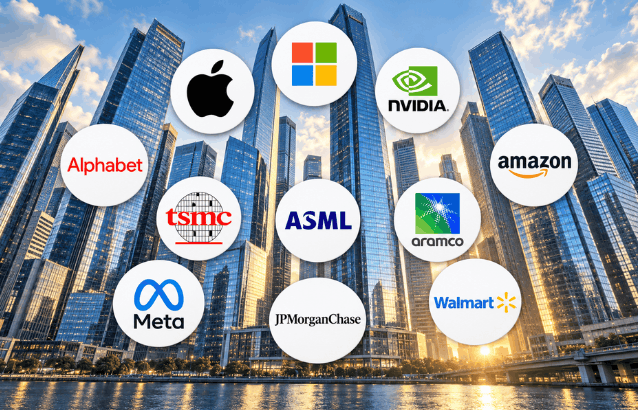
The most powerful companies in the world do a lot more than make impressive profits. They shape how we communicate, how businesses run and where whole industries put their money. Some supply essential resources, while others provide technology that millions of organisations rely on every day.
Microsoft, Apple and NVIDIA are the obvious examples, but corporate power goes well beyond tech. Banks connect businesses with capital, energy producers keep industry moving, and retailers shape global supply chains.
To really understand these companies, you have to look past their share prices. Their influence comes from a mix of financial strength, customer reach and capabilities that competitors struggle to copy.
What Makes a Company Powerful?
There’s no universally accepted ranking of corporate power. Market capitalisation measures the stock market value of a company’s outstanding shares, while revenue measures sales over a reporting period. Neither one fully explains why a business matters.
A company can also be powerful because it controls essential infrastructure, serves a huge customer network or supplies something that’s hard to replace.
The companies below are an editorial selection based on four factors: financial scale, market reach, competitive advantages and strategic importance. The numbering is just a reading order, not a league table, and the financial figures refer to the reporting periods stated.
11 of the World’s Most Powerful Companies
1. Microsoft: Embedded in Everyday Business
Microsoft’s influence starts with the tools businesses use every single day. Microsoft 365 supports workplace communication and productivity, while Azure provides the infrastructure for running applications, storing information and building AI services.
The financial results show just how far that reach goes. Microsoft reported fiscal 2026 revenue of $331.8 billion, with Azure revenue topping $100 billion after growing 41% year over year.
Once these connected services are part of an organisation, they’re hard to pull out. Switching provider can mean technical changes, staff training and operational disruption. That makes Microsoft’s established customer relationships a real competitive advantage, although it has to keep investing to hold on to them.
2. Apple: An Ecosystem That Encourages Loyalty
Microsoft is deeply tied to business operations, but Apple’s strength shows up most in consumer technology.
Its devices, operating systems and services all work together across products like the iPhone and Mac. Services such as iCloud, the App Store and Apple Pay stretch those relationships well beyond the first hardware purchase.
For customers using several Apple products, convenience can nudge them towards repeat purchases and ongoing spending on services. Developers and accessory makers build their own businesses around that ecosystem too.
So Apple’s power comes from how its brand, technology and customer relationships work together. Keeping that position depends on delivering products people continue to value.
3. NVIDIA: Supplying the Foundations of AI
NVIDIA has become strategically important through accelerated computing. Its platforms power demanding tasks like AI training, inference, scientific computing and data analysis.
And its advantage goes beyond processors. NVIDIA pairs its hardware with networking and a software ecosystem built around CUDA, including libraries and development tools.
That combination matters because businesses need systems that actually work, not just individual chips. Established software support makes it easier for developers to build and deploy applications.
NVIDIA shows how supplying a critical technology can create influence across multiple industries. Its position still depends on continued innovation, though, and on customers’ willingness to keep spending heavily on computing.
4. Alphabet: Connecting Information, Advertising and Computing
Alphabet, Google’s parent company, influences how people find information and how businesses reach potential customers. Search and YouTube link consumer attention with advertising, while Google Cloud serves enterprise customers.
That cloud business adds another layer to Alphabet’s influence. In the third quarter of 2026, Google Cloud revenue reached $30.7 billion, up 103% year over year.
So Alphabet plays a part in both the discovery of digital services and the infrastructure behind them. For businesses, changes across its platforms can affect visibility, customer acquisition and technology choices. Its future strength depends partly on adapting these services as AI changes how people behave online.
5. Amazon: Combining Commerce With Infrastructure
Amazon’s retail operations are the most visible part of the business, but AWS gives it another major source of influence.
In the third quarter of 2026, AWS generated $46 billion in revenue and $17.8 billion in operating income, which shows how important the cloud business is financially.
A company might sell through Amazon, advertise to its customers and run its applications on AWS. Those different relationships stretch Amazon’s reach across the business economy.
That scale also demands heavy investment. Maintaining delivery networks and expanding computing capacity takes serious capital, so investment discipline is an important part of Amazon’s long-term position.
6. TSMC: Manufacturing Technology Others Design
Behind many digital products sits a complex manufacturing process. Taiwan Semiconductor Manufacturing Company, or TSMC, specialises in producing chips for customers through its dedicated foundry model.
Its advanced manufacturing capabilities help explain why it matters so much. Processes of 7 nanometres and below accounted for 79% of wafer revenue in the third quarter of 2026.
Building comparable capabilities takes specialised equipment, technical expertise and huge investment, and customers can’t easily replace that combination.
TSMC shows why corporate influence isn’t always visible to consumers. A company can sit in a critical position in global production without selling anything under a familiar consumer brand.
7. ASML: A Critical Link in Chip Production
TSMC’s manufacturing role leads us to another key company: ASML.
The Dutch equipment maker describes itself as the world’s only manufacturer of extreme ultraviolet, or EUV, lithography systems, which support advanced semiconductor production.
ASML’s influence comes from supplying equipment that’s very difficult to substitute. Its importance depends less on consumer recognition than on the capabilities its customers need.
In October 2026, ASML said its planned supply for 2027 and 2028 would not fully meet customer demand. That outlook points to both strong demand and the challenge of scaling up highly specialised production.
8. Saudi Aramco: Supporting the Physical Economy
Digital infrastructure grabs the headlines, but transport and industry still need enormous amounts of energy.
Saudi Aramco operates across energy and chemicals, with upstream activities tied to Saudi Arabia’s hydrocarbon resources. Its financial scale is still substantial: the company reported $67.2 billion in adjusted net income for the first half of 2026.
Its influence reflects how important energy is to production, transportation and supply chains. Earnings remain exposed to commodity prices and operating conditions, though, and Aramco is a good example of how a strategically important business can still see big swings in profitability.
9. Meta Platforms: Turning Connection Into Commercial Reach
Meta’s strength comes from the sheer scale of its communication and content platforms, including Facebook, Instagram, Messenger and WhatsApp.
The company reported 3.64 billion average daily active people across its family of apps in September 2026. That figure counts people across the whole family, rather than adding up separate user totals.
An audience like that gives businesses ways to reach customers and gives creators ways to build communities. Network effects reinforce the appeal too, since people want to be on platforms where their contacts already are.
Keeping engagement and advertiser demand strong is therefore central to Meta’s influence.
10. JPMorgan Chase: Connecting Capital With Economic Activity
JPMorgan Chase represents a different kind of corporate power: financial intermediation.
Its operations span consumer banking, commercial and investment banking, and asset and wealth management. At September 30, 2026, it reported $5.1 trillion in assets. Bear in mind that assets measure the resources on its balance sheet and shouldn’t be confused with market capitalisation.
Through lending, payments and capital-market services, financial institutions help money flow through the economy.
JPMorgan Chase’s importance comes from the breadth of those connections, and its position also demands careful management of credit, liquidity and operational risks.
11. Walmart: Influencing Everyday Spending
Walmart’s power comes from its role in everyday consumption and product distribution.
Its operations combine physical stores, ecommerce and services that link digital orders with fulfilment through stores and clubs.
At this scale, decisions about purchasing, product selection and delivery can affect suppliers as well as customers, so Walmart’s influence goes well beyond what happens at the checkout.
Its position is also a reminder that leadership changes. Amazon overtook Walmart in the 2026 Fortune Global 500 revenue ranking, which shows how even established corporate leaders face competition.
How AI Is Changing Corporate Power
Put these companies together and an important pattern emerges: digital services depend on physical infrastructure. AI applications need computing platforms, which rely on chips, manufacturing equipment and energy.
The growth reported by Microsoft, Amazon and Alphabet suggests that supplying this infrastructure is becoming an increasingly important source of influence. That’s an interpretation of their results, rather than an official measure of corporate power.
Expansion has its costs too. Amazon reported negative free cash flow of $42.4 billion over the twelve months ended September 2026, alongside higher equipment spending mainly driven by AI investment. Growth and cash generation need to be judged together.
Is a Strong Company Always a Good Investment?
Corporate strength doesn’t automatically make a share attractive at any price. Valuation, future earnings, competition and investment requirements all matter.
Still, the most powerful companies in the world are a useful starting point for understanding the economy. To judge their lasting influence, ask yourself what they supply, who depends on them and how easily customers could find an alternative.
Frequently Asked Questions
Who is the most powerful company in the world?
There’s no official ranking. Microsoft is a strong candidate because of its influence across business software, cloud computing and AI.
What is the world’s No. 1 company?
It depends on the measure. Apple leads by market capitalisation as of November 2026, while Amazon tops the 2026 Fortune Global 500 by revenue.
What are the top 10 biggest companies?
By market capitalisation, Stock Analysis lists Apple, NVIDIA, Microsoft, Alphabet, Amazon, TSMC, SpaceX, Saudi Aramco, Tesla and Meta as of November 2026. Rankings change with market prices.
Which company is the strongest?
No single company is strongest in every area. Microsoft stands out in enterprise technology, Apple in consumer ecosystems and NVIDIA in AI computing.
Share Now
Disclaimer:This content is provided for informational purposes only and does not constitute, and should not be construed as, financial, investment, or other professional advice. No statement or opinion contained herein should be considered a recommendation by Ultima Markets or the author regarding any specific investment product, strategy, or transaction. Readers are advised not to rely solely on this material when making investment decisions and should seek independent advice where appropriate.
Thank you for visiting the Ultima Markets website. Please note that this website is intended for individuals residing in jurisdictions where access is permitted by law. Ultima and its affiliated entities do not operate in your home jurisdiction.
By clicking ‘Acknowledge’, you confirm that you are entering this website solely on your own initiative and not as a result of any specific marketing outreach. You wish to obtain information from this website based on reverse solicitation principles, in accordance with the applicable laws of your home jurisdiction.