This website is managed by Ultima Markets’ international entities, and it’s important to emphasise that they are not subject to regulation by the FCA in the UK. Therefore, you must understand that you will not have the FCA’s protection when investing through this website – for example:
You will not be guaranteed Negative Balance Protection
You will not be protected by FCA’s leverage restrictions
You will not have the right to settle disputes via the Financial Ombudsman Service (FOS)
You will not be protected by Financial Services Compensation Scheme (FSCS)
Any monies deposited will not be afforded the protection required under the FCA Client Assets Sourcebook. The level of protection for your funds will be determined by the regulations of the relevant local regulator.
Note: UK clients are kindly invited to visit https://www.ultima-markets.co.uk/. Ultima Markets UK expects to begin onboarding UK clients in accordance with FCA regulatory requirements in 2026.
If you would like to proceed and visit this website, you acknowledge and confirm the following:
1.The website is owned by Ultima Markets’ international entities and not by Ultima Markets UK Ltd, which is regulated by the FCA.
2.Ultima Markets Limited, or any of the Ultima Markets international entities, are neither based in the UK nor licensed by the FCA.
3.You are accessing the website at your own initiative and have not been solicited by Ultima Markets Limited in any way.
4.Investing through this website does not grant you the protections provided by the FCA.
5.Should you choose to invest through this website or with any of the international Ultima Markets entities, you will be subject to the rules and regulations of the relevant international regulatory authorities, not the FCA.
Ultima Markets wants to make it clear that we are duly licensed and authorised to offer the services and financial derivative products listed on our website. Individuals accessing this website and registering a trading account do so entirely of their own volition and without prior solicitation.
By confirming your decision to proceed with entering the website, you hereby affirm that this decision was solely initiated by you, and no solicitation has been made by any Ultima Markets entity.
Ultima Markets does not have an establishment in Singapore and does not operate from Singapore.
Ultima Markets does not provide products or services to citizens or residents of Singapore, and account applications from Singapore citizens or residents will not be accepted.
If you are a citizen or resident of Singapore, please do not open an account or use Ultima Markets’ products or services.
By selecting “Acknowledge and Continue Browsing”, you confirm that you are accessing this website on your own initiative and that your access is not the result of any direct marketing, targeted advertising, solicitation, or promotional activity by Ultima Markets.
Nothing on this website constitutes an offer, solicitation, or promotion of products or services in any jurisdiction where such activity is prohibited. You are responsible for ensuring that your access to and use of this website complies with applicable local laws and regulations.
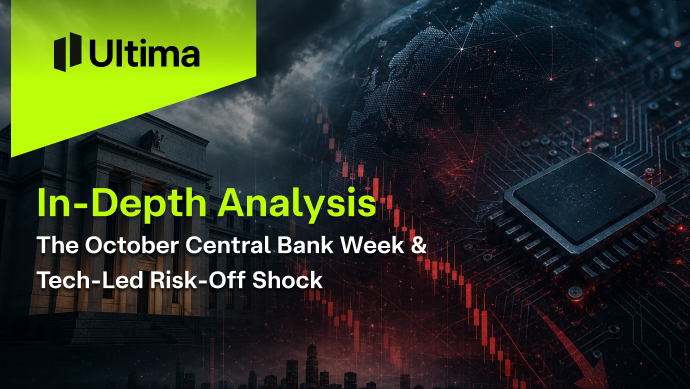
The October Central Bank Week & Tech-Led Risk-Off Shock
The October Central Bank Week & Tech-Led Risk-Off Shock
The final week of October 2026 has delivered a brutal reality check to global financial markets. We are currently witnessing a severe collision between restrictive global monetary policy and a sudden exhaustion in the AI-driven tech rally. As the Federal Reserve, Bank of Japan (BoJ), European Central Bank (ECB), and Bank of Canada (BoC) delivered their latest policy verdicts—continuing to constrain market liquidity—the market was simultaneously rocked by a violent “risk-off” shock triggered by AI capex skepticism and pessimistic tech earnings.
Here is an in-depth breakdown of the current market regime, the central bank actions, and the forward-looking impact on the US Dollar, US Equities, and Gold.
The Current Market: Tech Sell-Off & AI Skepticism
The broader market has decisively shifted into a “risk-off” posture. The catalyst was a wave of disappointing Q3 tech earnings that shattered the narrative of limitless AI profitability.
Most notably, Amazon reported a staggering free cash flow outflow of over $33 billion in Q3, while Intel shares plunged 20% in aftermarket trading due to a slowing PC market and surging memory prices. Furthermore, Chinese markets have shed trillions amid concerns over the profitability and sustainability of Beijing’s AI boom in the face of ongoing US technology bans.
When the cost of capital remains historically elevated due to central bank tightening, markets lose patience with massive “cash burn” projects. This AI capex skepticism has triggered heavy selling across global indices, with the Kospi dropping 4%, the Nikkei 225 sliding 2.5%, and US futures flashing deep red.
Central Bank Aftermath: The Fed & Global Tightening Remain on Path
With the broader market adopting a cautious and potentially deeper risk-off posture, last week’s global central bank decisions continued to point toward a tightening bias. This has further capped market liquidity and added pressure to risk assets. Most notably, the Federal Reserve and the Bank of Japan continue to have the heaviest impact on global liquidity.
1. The Federal Reserve (Fed): The Hawkish Hold
The Fed maintained its benchmark rate this week. While the surface tone appeared slightly less hawkish, the underlying message remained clear: data-dependent, but firmly hawkish. The decision was not unanimous; a 10-2 vote revealed two dissenting policymakers pushing for an immediate 25-basis-point hike. The Fed’s statement reiterated that “inflation remains elevated,” largely dampening any remaining hopes for an imminent pivot.
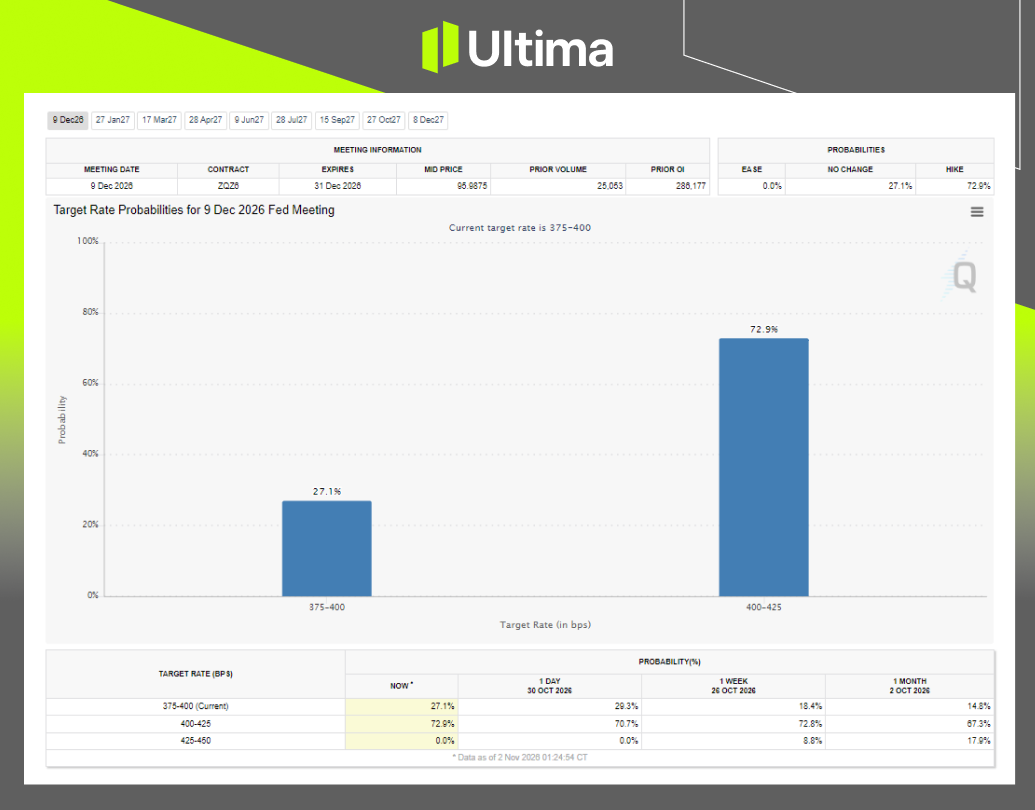
December Rate Hike Probabilities | Source: CME Group
The Fed’s refusal to back down—or more precisely, inflation’s refusal to back down—is acting as a lead weight on equity valuations. While a December move is not yet a certainty as we are still a month away from the decision, the market remains confident that a hike is highly probable. According to the latest CME interest rate futures data, the probability of a hike stood at 72.8% at the time of writing.
By keeping terminal rate expectations elevated while tech companies bleed cash, the Fed is fundamentally forcing capital out of speculative, high-beta tech stocks and into safer, yield-bearing assets.
2. Bank of Japan (BoJ): Hawkish Undercurrents at 1.25%
The BoJ held its overnight call rate at 1.25% (the highest level in 31 years). However, the details of the October 30 meeting were highly impactful. Governor Kazuo Ueda raised the inflation forecast for the next financial year to 2.6%, and one board member, Hajime Takata, openly dissented, calling for a hike to 1.5%. The BoJ also announced a systematic reduction in its ETF sales pace starting in 2027.
Market Impact: Japan is the world’s traditional funding currency. As the BoJ slowly but surely normalizes policy and signals a potential December hike, it drains global liquidity—compounding the headwinds generated by the tech and AI capex sell-off. The Yen edged up following the decision. While the immediate currency impact was relatively muted, this structural shift continues to pressure global risk assets as the era of cheap Japanese money draws to a close.
3. The Supporting Cast: BoC and ECB
Bank of Canada (BoC): While others held, the BoC delivered a hawkish surprise, raising its policy rate by 25 basis points to 2.50%. The Bank cited inflation projections remaining above 3% through much of 2027, driven specifically by sticky energy prices, elevated refinery margins, and a surprisingly resilient domestic economy. The BoC’s move serves as a stark warning to the market: if energy-driven inflation persists, central banks will not hesitate to resume hiking.
European Central Bank (ECB): The ECB was the least impactful of the major banks this week, holding rates steady. With the European economy stalling, market pricing for a December ECB hike has aggressively dropped to 69% (down from 90% earlier in the week). The ECB is essentially sidelined, waiting for clearer signals from the Fed and global energy markets before making its next move.
Asset Class Implications: US Dollar, US Equities & Gold
Given the current central bank outlook—coupled with upcoming decisions from the Reserve Bank of Australia (RBA) and the Bank of England (BoE), both of which are expected to lean hawkish—the coming weeks may remain challenging. Liquidity constraints will continue to weigh heavily on the markets and act as a primary driver of volatility.
1. The US Dollar (USD): Safe Haven vs. Treasury Rally
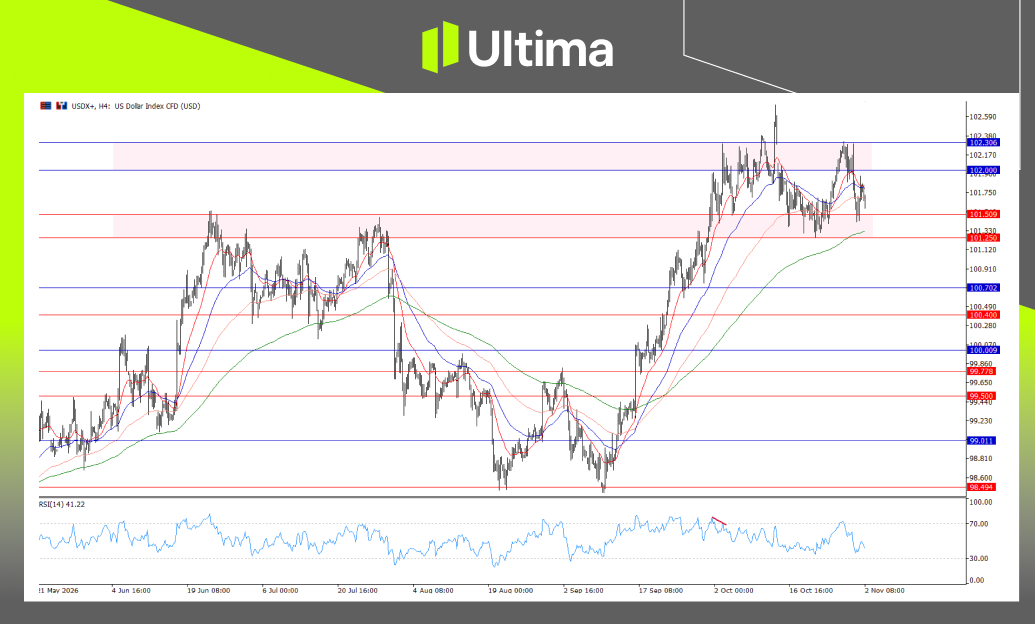
The US Dollar is currently caught in a complex dynamic. On one hand, the Fed’s hawkish 10-2 hold provides tremendous structural support. On the other hand, the sheer terror of the tech sell-off has driven a sudden “flight to safety” into US Treasuries, which pushes bond yields down.
Falling Treasury yields have placed temporary pressure on the Dollar. However, at the same time, AI jitters and broader risk aversion are allowing the safe-haven Dollar to gain ground.
USDX, H4 Chart | Source: Ultima Markets MT5
The US Dollar Outlook Timeline:
Short-Term: Cautious of potential technical pullbacks due to fluctuating Treasury yields.
Mid-to-Long Term: Safe-haven demand and structural liquidity constraints continue to firmly validate the Dollar’s bullish momentum.
In a prolonged “risk-off” liquidity crunch, the Dollar remains the ultimate safe haven. Expect the USD to remain highly resilient, particularly against risk-sensitive commodity currencies and the Euro, as global growth concerns mount.
2. Gold (XAU/USD): The Liquidity Squeeze
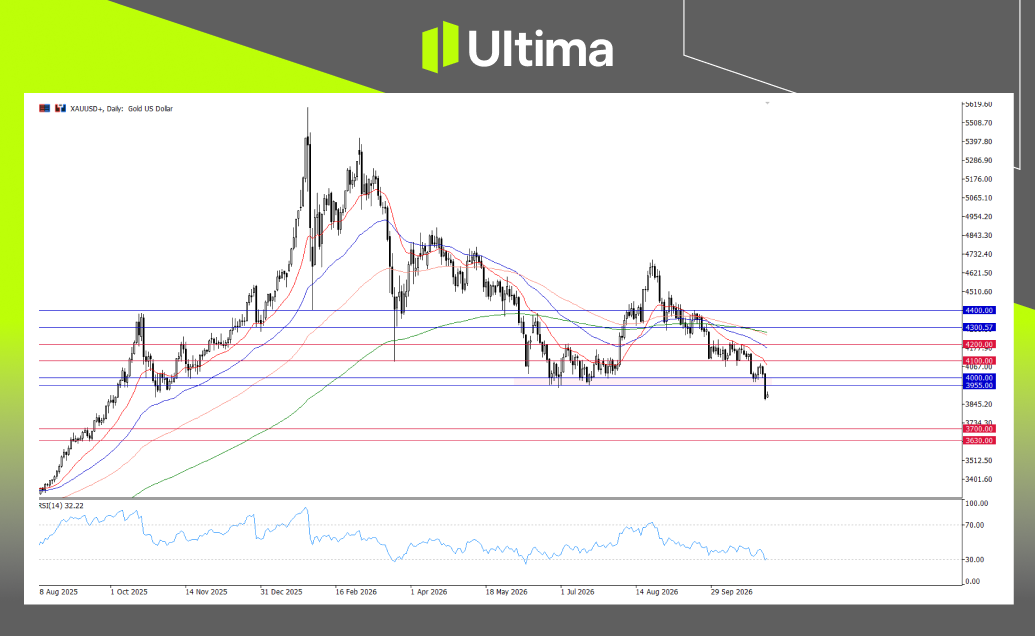
Paradoxically, Gold has failed to catch a massive safe-haven bid during this tech meltdown. After suffering a near 3% drop earlier in the week, spot gold has hovered relatively flat near $4,021 per ounce.
Outlook: Why isn’t gold soaring amid the stock market panic? In severe tech sell-offs, institutional investors often face margin calls. To cover these cash requirements, they are forced to liquidate their winning positions—which currently includes Gold.
Furthermore, the Fed’s insistence on holding rates high increases the opportunity cost of owning non-yielding assets.
While Gold’s long-term macro setup remains still potential due to central bank demand, traders must be incredibly cautious in the short to mid term; liquidity crunches can cause Gold to sell off further in tandem with equities before it eventually decouples and seeing a hope in recovery.
XAUUSD, Daily Chart | Ultima Markets MT5
Technically, Gold’s recent break below the $4,000 major psychological level—a demand zone that acted as a structural floor for over a year—marks a significant turning point. By printing a one-year low, the primary bullish defense zone is now considered broken, validating a structural bearish breakout.
Fundamentally, the current macroeconomic environment of constrained liquidity provides a severe headwind, opening the door for extended downside price action.
3. Nasdaq 100 (US Tech): The AI Capex Reality Check
The Nasdaq 100 remains the epicenter of the current market shock, bearing the brunt of AI capex skepticism and a string of pessimistic corporate earnings. The fundamental outlook for the tech-heavy index has deteriorated significantly, demanding a highly cautious approach from traders.
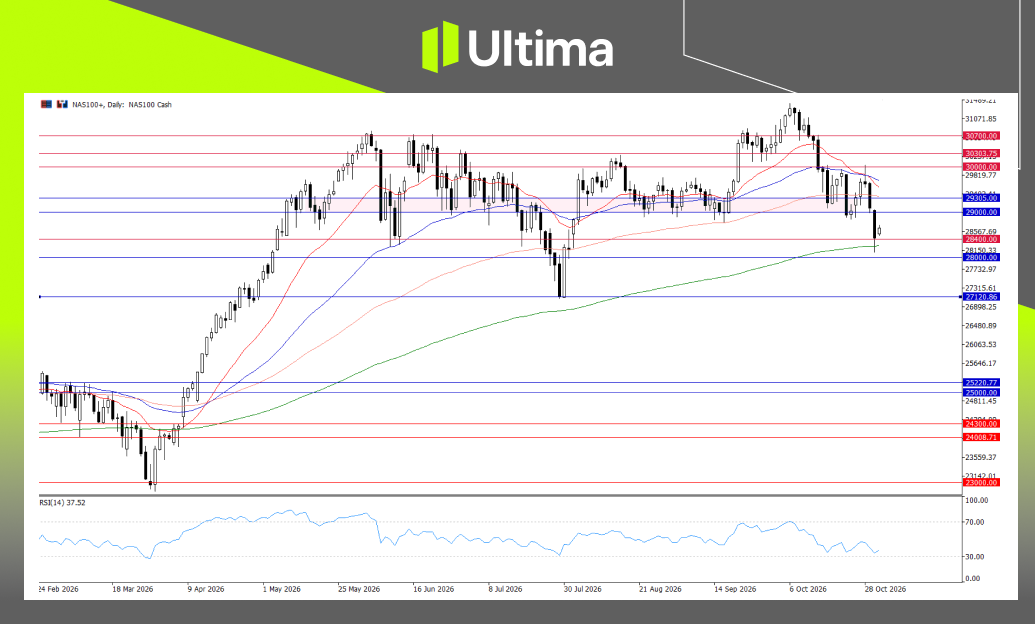
The index recently suffered a damaging breakdown below the critical 29,000 pivot level. While the Nasdaq is currently attempting to stabilize in a choppy, range-bound consolidation, price action indicates that this is merely a pause within a broader corrective wave, rather than a definitive market bottom.
NAS100, Daily Chart | Ultima Markets MT5
The combination of slowing tech profitability and a hawkish Federal Reserve draining liquidity leaves high-beta growth stocks highly vulnerable.
Traders must monitor the 28,000 structural support with extreme vigilance. A decisive daily close below the 28,000 handle will invalidate any lingering hopes for a near-term recovery, confirming a technical breakdown that will likely extend the index into a much deeper, prolonged bear market.
Upside potential remains strictly capped until global liquidity conditions fundamentally ease.
Navigating the Liquidity Crunch
Ultimately, the convergence of restrictive global monetary policy and the sudden exhaustion of the AI-driven tech rally has created a treacherous environment for risk assets. With central banks clearly prioritizing the inflation fight over market liquidity, the era of easy capital that fueled massive tech valuations is firmly on pause.
Moving forward, defensive positioning and strict risk management are paramount. The US Dollar is positioned to maintain its safe-haven dominance amidst the uncertainty, while highly leveraged equities and non-yielding assets like gold remain deeply vulnerable to further liquidity-driven liquidations.
The immediate market trajectory now hinges entirely on whether critical technical supports—particularly the Nasdaq’s 28,000 level—can withstand this relentless macroeconomic pressure test.
Disclaimer
Comments, news, research, analysis, price, and all information contained in the article only serve as general information for readers and do not suggest any advice. Ultima Markets has taken reasonable measures to provide up-to-date information, but cannot guarantee accuracy, and may modify without notice. Ultima Markets will not be responsible for any loss incurred due to the application of the information provided.
Thank you for visiting the Ultima Markets website. Please note that this website is intended for individuals residing in jurisdictions where access is permitted by law. Ultima and its affiliated entities do not operate in your home jurisdiction.
By clicking ‘Acknowledge’, you confirm that you are entering this website solely on your own initiative and not as a result of any specific marketing outreach. You wish to obtain information from this website based on reverse solicitation principles, in accordance with the applicable laws of your home jurisdiction.