This website is managed by Ultima Markets’ international entities, and it’s important to emphasise that they are not subject to regulation by the FCA in the UK. Therefore, you must understand that you will not have the FCA’s protection when investing through this website – for example:
You will not be guaranteed Negative Balance Protection
You will not be protected by FCA’s leverage restrictions
You will not have the right to settle disputes via the Financial Ombudsman Service (FOS)
You will not be protected by Financial Services Compensation Scheme (FSCS)
Any monies deposited will not be afforded the protection required under the FCA Client Assets Sourcebook. The level of protection for your funds will be determined by the regulations of the relevant local regulator.
Note: UK clients are kindly invited to visit https://www.ultima-markets.co.uk/. Ultima Markets UK expects to begin onboarding UK clients in accordance with FCA regulatory requirements in 2026.
If you would like to proceed and visit this website, you acknowledge and confirm the following:
1.The website is owned by Ultima Markets’ international entities and not by Ultima Markets UK Ltd, which is regulated by the FCA.
2.Ultima Markets Limited, or any of the Ultima Markets international entities, are neither based in the UK nor licensed by the FCA.
3.You are accessing the website at your own initiative and have not been solicited by Ultima Markets Limited in any way.
4.Investing through this website does not grant you the protections provided by the FCA.
5.Should you choose to invest through this website or with any of the international Ultima Markets entities, you will be subject to the rules and regulations of the relevant international regulatory authorities, not the FCA.
Ultima Markets wants to make it clear that we are duly licensed and authorised to offer the services and financial derivative products listed on our website. Individuals accessing this website and registering a trading account do so entirely of their own volition and without prior solicitation.
By confirming your decision to proceed with entering the website, you hereby affirm that this decision was solely initiated by you, and no solicitation has been made by any Ultima Markets entity.
Ultima Markets does not have an establishment in Singapore and does not operate from Singapore.
Ultima Markets does not provide products or services to citizens or residents of Singapore, and account applications from Singapore citizens or residents will not be accepted.
If you are a citizen or resident of Singapore, please do not open an account or use Ultima Markets’ products or services.
By selecting “Acknowledge and Continue Browsing”, you confirm that you are accessing this website on your own initiative and that your access is not the result of any direct marketing, targeted advertising, solicitation, or promotional activity by Ultima Markets.
Nothing on this website constitutes an offer, solicitation, or promotion of products or services in any jurisdiction where such activity is prohibited. You are responsible for ensuring that your access to and use of this website complies with applicable local laws and regulations.
Learn what F and O trading means, how futures and options work, key differences, expiry rules, trading costs and major risks beginners should understand.
F and O trading, short for futures and options trading, uses contracts linked to an underlying asset such as a share, index, currency or commodity. Rather than buying the asset directly, traders take a position on how its price may move before or at expiry.
Both are derivatives, but they work differently. Futures create obligations for the buyer and seller, while options give the buyer a right without requiring them to exercise it. This distinction is essential before entering the derivatives market.
What Does F and O Mean in the Share Market?
F and O means futures and options. Exchanges standardise these contracts by setting the underlying asset, lot size, expiry and settlement terms.
They are commonly used for speculation, hedging and arbitrage. Speculators seek returns from price changes, hedgers try to reduce an existing risk, and arbitrageurs look for price differences between related instruments. However, leverage can magnify both gains and losses.
What Is a Futures Contract?
A futures contract is an agreement to buy or sell a stated quantity of an asset at a specified price on a future date. Both parties remain obligated unless they close the position before expiry.
Futures are traded in lots and require margin rather than payment of the full notional value. Positions are marked to market as prices change. NSE Clearing states that open futures positions are reset to the daily settlement price, with profits and losses settled through clearing members.
For example, suppose a contract is priced at ₹500 with a hypothetical lot size of 100. A rise to ₹515 creates a gross gain of ₹1,500. A fall to ₹485 creates a gross loss of ₹1,500, before taxes and other charges.
What Is an Options Contract?
An option gives its buyer the right, but not the obligation, to buy or sell an underlying asset at a predetermined strike price. The buyer pays the seller a premium for this right.
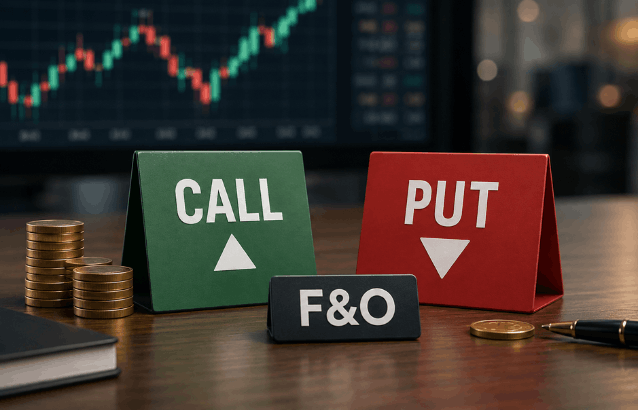
A call option provides the right to buy, while a put option provides the right to sell. The option seller accepts the corresponding obligation if the contract is exercised or assigned.
For buyers, the contract loss is generally limited to the premium and charges. Sellers may face much larger losses, especially with uncovered positions. Option prices are also affected by time to expiry and expected volatility.
Futures vs Options: Key Differences
Feature
Futures
Options
Buyer
Has an obligation
Has a right
Seller
Has an obligation
Must perform if exercised
Initial outlay
Margin
Buyer pays a premium
Price
Closely follows the underlying
Also affected by time and volatility
Expiry
Closed or settled
May expire without intrinsic value
Risk
Loss may exceed initial margin
Buyer usually risks the premium; seller may risk more
This is the main difference in F and O trading. Futures provide more direct exposure to price movements, while options support a wider range of risk and return structures.
Important F&O Terms
A lot size is the number of units in one contract. The strike price is the agreed option price, while the premium is what the option buyer pays. Margin is the capital or collateral required for certain positions.
Expiry is the date the contract ends, and open interest measures contracts that remain open. Options may be in the money, at the money or out of the money, depending on the strike price compared with the underlying price.
What Happens When an F&O Contract Expires?
The outcome depends on the product. SEBI’s 2025-26 annual report states that Indian index futures and options are cash-settled. Stock futures and options held until expiry require physical settlement, which may create an obligation to deliver shares or provide sufficient funds.
NSE states that individual stock options are European style, meaning exercise occurs at expiry. Its current specifications list the last Tuesday of the expiry month for individual stock futures and options, although exchange schedules may change.
Always check the latest contract terms rather than relying on an old general rule.
Why Do Traders Use Futures and Options?
These contracts allow traders to take bullish or bearish positions without paying the full value of the underlying asset. They can also be used to hedge an existing portfolio. For example, an investor concerned about a decline might use index futures or put options to offset part of the risk.
The lower upfront outlay may appear capital-efficient, but it does not make derivatives low-risk.
F&O Trading Costs and STT in 2026
Costs may include brokerage, exchange charges, GST, stamp duty, Securities Transaction Tax and the bid-ask spread.
From 1 April 2026, STT on securities futures increased to 0.05% of the traded price. STT on the sale of securities options increased to 0.15% of the premium, while exercised options are subject to 0.15% of intrinsic value.
SEBI reported that June 2026 equity futures average daily turnover was 21.4% below March, while premium options turnover was 30.8% lower. It said the moderation likely reflected the STT revision and lower market volatility.
What Are the Main Risks of F&O Trading?
Major risks include leverage, margin calls, expiry, time decay, volatility, poor liquidity and settlement obligations. A trader can predict the broad direction correctly but still lose if the move is too small, arrives too late or fails to cover the premium and costs.
Official data underline these risks. An August 2026 Rajya Sabha reply reported that 78.6 lakh individuals traded equity F&O in FY26, based on data covering around 90% of individual investors. Their combined net loss was ₹91,685 crore, while the average loss per person reached ₹1,16,654. Participation and total losses declined from FY25, but the average loss increased.
Is F&O Trading Suitable for Beginners?
Derivatives trading is complex and may not suit everyone. Beginners should understand leverage, margin, premium, expiry and settlement before risking capital. A simulator, smaller exposure and a defined maximum loss can help reduce avoidable mistakes, although they cannot remove risk.
Traders should also confirm that their intermediary is appropriately regulated and check current exchange specifications before opening a position.
F&O Trading vs CFD Trading
F&O contracts and contracts for difference are both derivatives, but their structures differ. Exchange-traded futures and options use standardised terms and fixed expiries. CFDs are generally over-the-counter products offered by a provider, so their costs, margin conditions and expiry arrangements may differ.
Conclusion
Futures and options can be used to speculate, hedge risk and gain leveraged market exposure. Futures create obligations for both sides, while options give the buyer a right in return for a premium.
Before trading, check the lot size, expiry, settlement method, margin requirement and total costs. Most importantly, calculate the possible loss rather than focusing only on the potential return.
FAQs
What is the full form of F and O?
F and O stands for futures and options.
Can beginners trade in F&O?
They can, but should first understand leverage, expiry and settlement risk.
Can F&O losses exceed the initial amount?
Yes. Futures and some option-selling positions can lose more than the initial margin.
Share Now
Disclaimer:This content is provided for informational purposes only and does not constitute, and should not be construed as, financial, investment, or other professional advice. No statement or opinion contained herein should be considered a recommendation by Ultima Markets or the author regarding any specific investment product, strategy, or transaction. Readers are advised not to rely solely on this material when making investment decisions and should seek independent advice where appropriate.
Thank you for visiting the Ultima Markets website. Please note that this website is intended for individuals residing in jurisdictions where access is permitted by law. Ultima and its affiliated entities do not operate in your home jurisdiction.
By clicking ‘Acknowledge’, you confirm that you are entering this website solely on your own initiative and not as a result of any specific marketing outreach. You wish to obtain information from this website based on reverse solicitation principles, in accordance with the applicable laws of your home jurisdiction.