This website is managed by Ultima Markets’ international entities, and it’s important to emphasise that they are not subject to regulation by the FCA in the UK. Therefore, you must understand that you will not have the FCA’s protection when investing through this website – for example:
You will not be guaranteed Negative Balance Protection
You will not be protected by FCA’s leverage restrictions
You will not have the right to settle disputes via the Financial Ombudsman Service (FOS)
You will not be protected by Financial Services Compensation Scheme (FSCS)
Any monies deposited will not be afforded the protection required under the FCA Client Assets Sourcebook. The level of protection for your funds will be determined by the regulations of the relevant local regulator.
Note: UK clients are kindly invited to visit https://www.ultima-markets.co.uk/. Ultima Markets UK expects to begin onboarding UK clients in accordance with FCA regulatory requirements in 2026.
If you would like to proceed and visit this website, you acknowledge and confirm the following:
1.The website is owned by Ultima Markets’ international entities and not by Ultima Markets UK Ltd, which is regulated by the FCA.
2.Ultima Markets Limited, or any of the Ultima Markets international entities, are neither based in the UK nor licensed by the FCA.
3.You are accessing the website at your own initiative and have not been solicited by Ultima Markets Limited in any way.
4.Investing through this website does not grant you the protections provided by the FCA.
5.Should you choose to invest through this website or with any of the international Ultima Markets entities, you will be subject to the rules and regulations of the relevant international regulatory authorities, not the FCA.
Ultima Markets wants to make it clear that we are duly licensed and authorised to offer the services and financial derivative products listed on our website. Individuals accessing this website and registering a trading account do so entirely of their own volition and without prior solicitation.
By confirming your decision to proceed with entering the website, you hereby affirm that this decision was solely initiated by you, and no solicitation has been made by any Ultima Markets entity.
Ultima Markets does not have an establishment in Singapore and does not operate from Singapore.
Ultima Markets does not provide products or services to citizens or residents of Singapore, and account applications from Singapore citizens or residents will not be accepted.
If you are a citizen or resident of Singapore, please do not open an account or use Ultima Markets’ products or services.
By selecting “Acknowledge and Continue Browsing”, you confirm that you are accessing this website on your own initiative and that your access is not the result of any direct marketing, targeted advertising, solicitation, or promotional activity by Ultima Markets.
Nothing on this website constitutes an offer, solicitation, or promotion of products or services in any jurisdiction where such activity is prohibited. You are responsible for ensuring that your access to and use of this website complies with applicable local laws and regulations.
What is a paper silver? Compare the differences between paper silver vs physical silver. Learn about its risks and benefits for traders and investors.
Silver has long been viewed as both a precious metal and an industrial commodity. While investors have traditionally bought silver bars and coins as a store of value, modern markets offer another way to gain exposure to silver prices through financial products.
This has led to growing interest in paper silver, especially among traders looking for flexible ways to follow silver price movements without owning physical metal. But how does paper silver work, and how does it compare with physical silver?
Understanding the differences between paper silver vs physical silver can help traders and investors decide which option better fits their goals, risk preferences and market approach.
What Is Paper Silver?
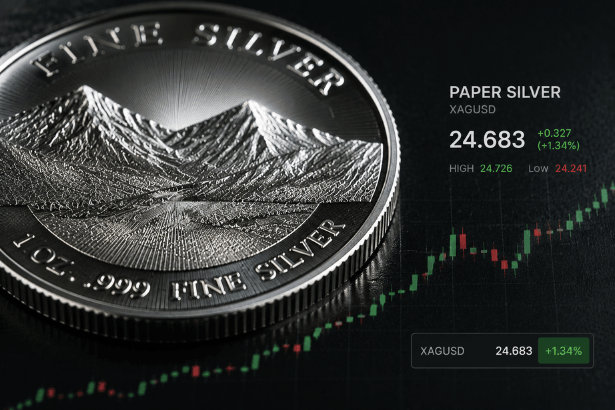
Paper silver refers to financial products that track the price of silver without requiring investors to own the physical metal. Instead of holding silver bars or coins, traders hold a financial instrument linked to silver price movements.
Common examples of paper silver include:
Silver futures contracts
Silver exchange-traded funds (ETFs)
Silver contracts for difference (CFDs)
Silver options
Unallocated silver accounts
The value of these products generally moves based on the price of silver in global markets. If silver prices rise, a long position in a paper silver product may increase in value. If silver prices fall, the position may lose value.
Unlike physical silver, paper silver focuses on gaining exposure to price movements rather than owning the underlying asset.
How Does Paper Silver Work?
Paper silver works through financial markets where buyers and sellers trade contracts based on expectations of future silver prices.
For example, a trader who believes silver prices may rise can open a position linked to silver’s price. If the market moves in the expected direction, the trader may benefit from the price difference. However, if silver moves against the position, losses may occur.
One of the main reasons traders use paper silver is flexibility. Positions can usually be opened and closed quickly, allowing traders to respond to market changes, economic data releases and technical signals.
Silver prices can be influenced by several factors, including:
US dollar movements
Interest rate expectations
Inflation concerns
Industrial demand
Global economic conditions
Because silver has both precious metal and industrial characteristics, it can experience significant price movements compared with other traditional assets.
Types of Paper Silver Products
Not all paper silver products work in the same way.
Silver Futures
Silver futures are exchange-traded contracts that allow market participants to buy or sell silver at a future date and predetermined price. Futures are widely used by institutions, miners and traders to manage price exposure.
Silver ETFs
Silver ETFs allow investors to gain exposure to silver prices through shares traded on stock exchanges. Some ETFs are backed by physical silver holdings, while others may use different structures.
Silver CFDs
Silver CFDs allow traders to speculate on silver price movements without owning the metal. CFDs are commonly used for short-term trading because they offer flexibility and access to both rising and falling markets.
However, leverage can increase both potential gains and potential losses, making risk management an important part of trading.
Key Differences of Paper Silver vs Physical Silver
The biggest difference between paper silver and physical silver is ownership.
Feature
Paper Silver
Physical Silver
Ownership
Financial exposure to silver prices
Direct ownership of silver metal
Storage
No storage required
Requires secure storage
Liquidity
Generally easier to trade
Selling may take longer
Costs
Spreads, fees or management costs
Dealer premiums, storage and insurance
Trading flexibility
Can usually trade short and long positions
Mainly focused on ownership
Physical access
Usually no direct access to metal
Investor holds the actual asset
Why Do Traders Choose Paper Silver?
Easier access to silver price movements
One of the biggest advantages of paper silver is convenience. Traders can gain exposure to silver prices without buying, transporting or storing physical metal.
This makes it attractive for those who focus on market opportunities rather than long-term ownership.
Higher liquidity
Paper silver products are generally easier to enter and exit compared with physical silver. Traders can respond quickly to changes in market conditions without needing to find buyers or sellers for physical metal.
Ability to trade different market conditions
Some paper silver products allow traders to take both long and short positions. This means traders can potentially benefit from both rising and falling silver prices depending on their market view.
Access to leverage
Certain paper silver products provide leverage, allowing traders to control a larger position with less initial capital.
However, leverage also increases risk. A small market movement can have a larger impact on a leveraged position, making proper risk management essential.
Risks of Paper Silver
Although paper silver offers flexibility, it also comes with several considerations.
No direct ownership of silver
The main limitation of paper silver is that traders usually do not own the actual metal. A paper silver position represents exposure to price movements, not ownership of silver bars or coins.
For investors who want a tangible asset they can physically hold, physical silver may be a more suitable option.
Financial product risks
Different paper silver products have different structures, fees and conditions. Traders should understand how each product works before participating.
Market volatility
Silver prices can change quickly due to economic data, central bank policies, currency movements and changes in industrial demand.
While volatility creates trading opportunities, it can also increase risk.
Why Do Investors Choose Physical Silver?
Physical silver appeals mainly to investors who prefer direct ownership.
Owning silver bars or coins provides a tangible asset that is not dependent on a financial contract or trading platform. Some investors view precious metals as a way to diversify their portfolios during periods of economic uncertainty.
However, physical silver also comes with challenges. Investors need to consider storage, security, insurance costs and the potential difficulty of selling large amounts quickly.
Does Paper Silver Affect Silver Prices?
Paper silver markets play an important role in global silver price discovery. Futures markets, for example, allow producers, manufacturers and investors to manage price risks.
However, trading paper silver does not always mean physical silver changes hands. Many financial contracts are settled without physical delivery, meaning paper markets and physical markets can sometimes experience different supply and demand pressures.
This is why some investors compare paper silver vs physical silver when analysing the broader silver market.
Should You Buy Paper Silver or Physical Silver?
The choice depends on your objective.
Paper silver may be more suitable for traders who:
Want exposure to short-term silver price movements
Prefer higher liquidity
Use market analysis and trading strategies
Want easier access without storage concerns
Physical silver may be more suitable for investors who:
Prefer direct ownership
Have a long-term holding approach
Want a tangible asset
There is no single option that is suitable for everyone. The better choice depends on whether the goal is trading silver price movements or owning silver as a long-term asset.
Conclusion
The debate between paper silver vs physical silver comes down to the difference between trading exposure and owning the underlying metal.
Paper silver provides flexibility, liquidity and easier access to silver markets, making it popular among active traders. Physical silver provides direct ownership but requires investors to consider storage, security and selling costs.
Before choosing between paper silver and physical silver, understanding how each option works is an important step towards making informed decisions in the silver market.
FAQs
What is paper silver?
Paper silver is a financial product that tracks silver prices without requiring ownership of physical silver. Examples include futures, ETFs and CFDs.
Is paper silver safer than physical silver?
Both have different risks. Paper silver involves financial market risks, while physical silver involves storage and liquidity considerations.
Which is better, paper silver or physical silver?
It depends on your goal. Traders often prefer paper silver for flexibility, while long-term investors may prefer physical silver ownership.
Share Now
Disclaimer:This content is provided for informational purposes only and does not constitute, and should not be construed as, financial, investment, or other professional advice. No statement or opinion contained herein should be considered a recommendation by Ultima Markets or the author regarding any specific investment product, strategy, or transaction. Readers are advised not to rely solely on this material when making investment decisions and should seek independent advice where appropriate.
Thank you for visiting the Ultima Markets website. Please note that this website is intended for individuals residing in jurisdictions where access is permitted by law. Ultima and its affiliated entities do not operate in your home jurisdiction.
By clicking ‘Acknowledge’, you confirm that you are entering this website solely on your own initiative and not as a result of any specific marketing outreach. You wish to obtain information from this website based on reverse solicitation principles, in accordance with the applicable laws of your home jurisdiction.