This website is managed by Ultima Markets’ international entities, and it’s important to emphasise that they are not subject to regulation by the FCA in the UK. Therefore, you must understand that you will not have the FCA’s protection when investing through this website – for example:
You will not be guaranteed Negative Balance Protection
You will not be protected by FCA’s leverage restrictions
You will not have the right to settle disputes via the Financial Ombudsman Service (FOS)
You will not be protected by Financial Services Compensation Scheme (FSCS)
Any monies deposited will not be afforded the protection required under the FCA Client Assets Sourcebook. The level of protection for your funds will be determined by the regulations of the relevant local regulator.
Note: UK clients are kindly invited to visit https://www.ultima-markets.co.uk/. Ultima Markets UK expects to begin onboarding UK clients in accordance with FCA regulatory requirements in 2026.
If you would like to proceed and visit this website, you acknowledge and confirm the following:
1.The website is owned by Ultima Markets’ international entities and not by Ultima Markets UK Ltd, which is regulated by the FCA.
2.Ultima Markets Limited, or any of the Ultima Markets international entities, are neither based in the UK nor licensed by the FCA.
3.You are accessing the website at your own initiative and have not been solicited by Ultima Markets Limited in any way.
4.Investing through this website does not grant you the protections provided by the FCA.
5.Should you choose to invest through this website or with any of the international Ultima Markets entities, you will be subject to the rules and regulations of the relevant international regulatory authorities, not the FCA.
Ultima Markets wants to make it clear that we are duly licensed and authorised to offer the services and financial derivative products listed on our website. Individuals accessing this website and registering a trading account do so entirely of their own volition and without prior solicitation.
By confirming your decision to proceed with entering the website, you hereby affirm that this decision was solely initiated by you, and no solicitation has been made by any Ultima Markets entity.
Ultima Markets does not have an establishment in Singapore and does not operate from Singapore.
Ultima Markets does not provide products or services to citizens or residents of Singapore, and account applications from Singapore citizens or residents will not be accepted.
If you are a citizen or resident of Singapore, please do not open an account or use Ultima Markets’ products or services.
By selecting “Acknowledge and Continue Browsing”, you confirm that you are accessing this website on your own initiative and that your access is not the result of any direct marketing, targeted advertising, solicitation, or promotional activity by Ultima Markets.
Nothing on this website constitutes an offer, solicitation, or promotion of products or services in any jurisdiction where such activity is prohibited. You are responsible for ensuring that your access to and use of this website complies with applicable local laws and regulations.
Discover the causes and impact of Black Tuesday 1929, the stock market crash, and learn how to prepare for future stock market crashes and predictions.
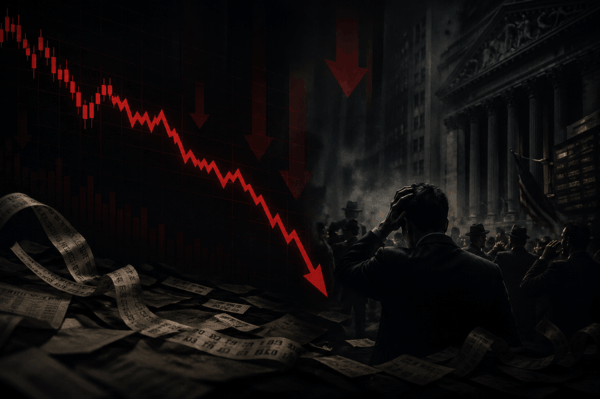
Black Tuesday, which occurred on October 29, 1929, remains one of the most significant and catastrophic days in the history of the stock market. It marked the dramatic conclusion of the Stock Market Crash of 1929, which led to the start of the Great Depression.
To understand the magnitude of this event, it’s essential to explore the background leading to the crash, the events of Black Tuesday itself, and the lasting consequences for both the U.S. economy and the global financial system.
The Roaring Twenties: A Precursor to Crisis
The 1920s, often known as the Roaring Twenties, were a time of rapid economic expansion and booming consumerism in the United States. The stock market experienced rapid growth, and by the end of the decade, the Dow Jones Industrial Average (DJIA) had risen more than six-fold. Optimism was high, and many believed that this growth would continue indefinitely.
However, underneath this prosperity lay significant economic instability. Many people were buying stocks based on the assumption that prices would continue to rise.
This speculative bubble was fueled by buying on margin, where investors borrowed money to purchase more stocks, often with little to no regard for the underlying value of the companies they were investing in.
A Speculative Bubble: The Build-Up to the Crash
By 1929, the stock market had become highly speculative, with many stocks trading far above their actual value. Investors believed that stock prices would continue rising, and as a result, they were willing to take on significant debt.
Despite warning signs of economic strain in other sectors, such as agriculture and industry, the market remained buoyant until the early fall of 1929.
However, by late September 1929, prices began to show signs of instability. Although these early signs of a downturn were ignored by many investors, they eventually led to a series of events that culminated in the Stock Market Crash of 1929. Among these were:
Speculation: Stock prices became inflated due to excessive speculation.
Margin buying: Borrowing money to buy stocks led to increased vulnerability when prices started to fall.
Lack of regulation: There was little oversight to prevent speculative trading and ensure stock values reflected underlying company fundamentals.
The Events of Black Thursday and Black Monday
The decline began on October 24, 1929, Black Thursday, when panic set in. On this day, a massive sell-off occurred, with 12.9 million shares traded, far exceeding the usual trading volume.
Even though wealthy bankers, including J.P. Morgan, attempted to stabilize the market by purchasing stocks, it was too late. The market closed with significant losses, signalling that the market was in trouble.
The panic intensified over the weekend, and Black Monday (October 28, 1929) saw even greater losses, with the DJIA falling by nearly 13%. This marked the beginning of a larger financial catastrophe, but the worst day was yet to come.
The Chaos of Black Tuesday
Black Tuesday arrived on October 29, 1929, and was the most devastating day of the crash. On this day, 16.4 million shares were traded, overwhelming the stock exchange and causing a massive collapse in stock prices. Investors, fearing further losses, rushed to sell their stocks, exacerbating the downward spiral.
By the end of the day, the market had lost an estimated $14 billion in value, which would be equivalent to hundreds of billions of dollars in today’s terms. The loss represented 12.8% of the market’s value in a single day.
This was not just a market correction; it was the complete collapse of investor confidence, and the effects were felt almost immediately.
Causes of the Stock Market Crash of 1929
The events of Black Tuesday were the result of several interrelated causes:
1. Excessive Speculation
Speculative investing, driven by the belief that stock prices would continue to rise, caused stocks to be overvalued. Many investors bought stocks without regard for the companies’ financial health, leading to a bubble.
2. Margin Debt and Leverage
Investors were using borrowed money to buy stocks on margin, which amplified both potential profits and risks. When the market began to fall, investors were forced to sell their stocks to cover their debts, causing prices to drop even further.
3. Lack of Regulation
The stock market was not properly regulated at the time, which allowed for reckless speculation and risky practices like margin buying. The absence of proper oversight meant that investors were unaware of the risks they were taking on.
4. Economic Weakness
While the stock market was booming, other parts of the economy, such as agriculture and industry, were struggling. This weakness in the broader economy created an unstable foundation for the stock market’s growth, making it more vulnerable to a crash.
Immediate Impact of the Crash
The effects of Black Tuesday were not confined to the stock market. The crash triggered a widespread banking crisis, with many banks that had invested heavily in stocks or lent money to stock investors facing insolvency. As banks failed, people lost their savings, further deepening the crisis.
Unemployment soared, and many businesses shuttered, unable to access the credit they needed to stay afloat. The Great Depression had begun, and its effects would last for years.
The Global Consequence
While the crash initially impacted the U.S. economy, its effects were felt worldwide. Global trade declined sharply, and economies in Europe, Latin America, and other regions also entered downturns.
The stock market crash worsened the already fragile global economy and contributed to the global economic depression that would last for over a decade.
Financial Reforms After the Crash
In the wake of the crash and the Great Depression, the U.S. government took significant steps to prevent a similar disaster from occurring again. Some of the key reforms included:
Securities Exchange Act (1934): Established the Securities and Exchange Commission (SEC) to regulate the stock market and ensure greater transparency.
Glass-Steagall Act (1933): Separated commercial and investment banking to reduce the risks associated with speculative trading.
Social Security Act (1935): Provided social safety nets like unemployment insurance and pensions to help people during times of economic hardship.
These reforms laid the groundwork for a more regulated and transparent financial system, which helped restore confidence in the markets and prevent another crash of similar magnitude.
Conclusion
Black Tuesday was the climax of the Stock Market Crash of 1929, a disaster that not only wiped out billions in wealth but also ushered in the Great Depression.
The crash exposed the dangers of speculative investing, excessive debt, and lack of regulation, prompting significant reforms that reshaped the financial landscape in the U.S. and around the world.
As we look ahead, it’s important to consider the next stock market crash prediction and understand how to prepare for a stock crash. By staying informed, practising sound investment strategies, and maintaining a diversified portfolio, investors can navigate future market challenges with greater confidence.
FAQs
What caused Black Tuesday?
Black Tuesday was caused by excessive speculation, margin buying, and an overvalued stock market. When prices started to fall, panic selling exacerbated the crash.
How did Black Tuesday affect the global economy?
The crash triggered a global economic downturn, leading to widespread unemployment, bank failures, and a contraction in global trade, ultimately resulting in the Great Depression.
What reforms were introduced after the crash?
After the crash, key reforms like the Securities and Exchange Commission (SEC) and the Glass-Steagall Act were introduced to regulate the stock market and prevent future financial crises.
Share Now
Disclaimer:This content is provided for informational purposes only and does not constitute, and should not be construed as, financial, investment, or other professional advice. No statement or opinion contained herein should be considered a recommendation by Ultima Markets or the author regarding any specific investment product, strategy, or transaction. Readers are advised not to rely solely on this material when making investment decisions and should seek independent advice where appropriate.
Thank you for visiting the Ultima Markets website. Please note that this website is intended for individuals residing in jurisdictions where access is permitted by law. Ultima and its affiliated entities do not operate in your home jurisdiction.
By clicking ‘Acknowledge’, you confirm that you are entering this website solely on your own initiative and not as a result of any specific marketing outreach. You wish to obtain information from this website based on reverse solicitation principles, in accordance with the applicable laws of your home jurisdiction.